Sunday, March 9, 2014

Where Does the Line Between Data Modeler and DBA Fall? | LinkedIn Group: InfoAdvisors Members

Follow the LinkedIn discussion

My comment 

I agree with your [Karen Lopez] "State of the Union" of Data Modeling as described in your post related to this discussion. Leaving possible and probable reasons aside that led to that state, I will here focus on your question.
According to my observations, organizations have lost (and some never adopted) the technique of targeted denormalization which bridges the gap between the logical data model and the physical database design and thus brings Data Modelers and DBAs together.
Based on a 3-level approach (I skip to discuss the steps that lead to a Logical Data Model), responsibilities of Data Modelers, Developers and DBAs can be assigned as follows:
  • Logical Data Model: developed by Data Modelers / Data Administrators
  • Transition Model: created by Developers and DBAs to denormalize the Logical Data Model according to the requirements of the application (create physical tables, views, indexes etc.)
  • Physical Database Model: based on the Transition Model, DBAs add physical parameters allowing to completely generate the DDL for the (production) database
To be consequently followed by Data Modelers, Developers and DBAs, the above 3-level approach does not only need to be advised and backed by senior management, but it requires a data modeling tool that will make it "unattractive" for anyone to seek "practical shortcuts". To be suitable for that approach, the data modeling tool e.g. has to
  • Support denormalization of Logical Data Models
  • Keep track of the lineage through the transformation process from logical tables/columns to database tables/columns
  • Offer mechanisms that automatically propagate modifications from the Logical Data Model to subsequent levels (for modifications where the methodology is algorithmic and does not require human intervention)
  • Offer mechanisms that allow to manually integrate modifications from the Logical Data Model to subsequent levels (for modifications where design decisions need to be taken)
  • Include an interface that generates the script to create / alter the database (DDL) from the Physical Database Model.

How to model a ternary associative entity with a binary constraint? | LinkedIn Group: Data Modeling

Follow the LinkedIn discussion

My comment 

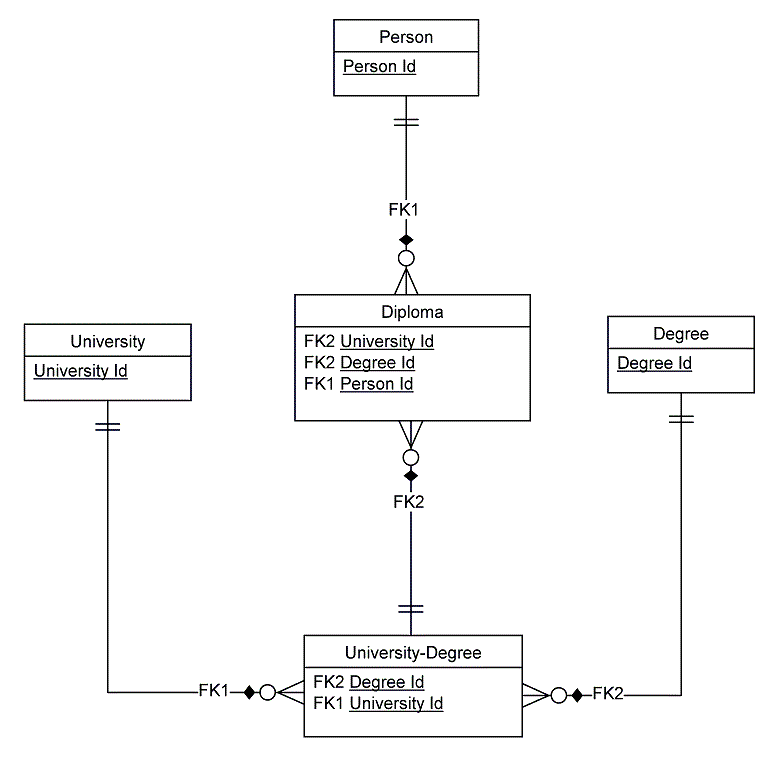
Based on the information provided (and including your later remark that this is just a hypothetical conceptual model to help illustrate a concept), Option A shows the right model.

Additional relationships as of your options B and C are redundant since they do not add any semantics to the model that are not already expressed in Option A. Practical test: If you generate foreign keys, the model as of Option A will look as shown at http://www.silverrun.com/common/ternary-example-red.gif (using the notation "Information Engineering +"). 


Click on image to enlarge it

The foreign keys in the table Diploma still allow a direct navigation to the table University and the table Degree (and vice versa).

Sunday, February 2, 2014

A Master Data Mind Map | LinkedIn Group: DAMA International

Follow the LinkedIn discussion

My comment 

Starting with a mind map is definitely a more "relaxed" technique during the brainstorming stage of an MDM endeavor, compared to immediately using a data modeling tool. The relationships between master data entities are simply specializations, so, at the first stage, the creative process is not overloaded with the pressure to name relationships and assign cardinalities.

Therefore, this approach is more suitable to obtain acceptance from the target audience (stakeholders / representatives of the business units). Their engagement and contributions are not only indispensable to find and define master data entities as the center of operational transactions, but also to build a sustainable basis for analytics processes: As you mentioned in your blog, master data are about the Who (Party), What (Product / Service) and Where (Location), i.e. these master data entity categories (together with When = Time) also define the dimensions of the analytics space, as most business questions can be projected into and then answered from this 4-dimensional structure.

Modeling of un-structured data | LinkedIn Group: Data Architect USA

Follow the LinkedIn discussion

My comment 

All business-relevant data should be modeled in only one tool to ensure the integrity between logical enterprise models, logical subject area models and application-specific DBMS models.

Differences between modeling techniques for SQL databases, NoSQL databases and other storage / retrieval technologies only occur on the physical level. In a nutshell, while SQL database models 'may' be denormalized, NoSQL database models 'must' (almost always) be denormalized (due to rare to no support of table joins).

In any event, professional data modeling tools (should) offer such denormalization support while keeping track of the column lineage.

The Business Architecture tool SILVERRUN in its latest version (published last week) features modeling Cassandra 2.0 databases incl. the generation of CQL scripts (see http://www.silverrun.com/silverrun-news-nosql-cassandra-modeling.html ) Additional SILVERRUN versions including reverse engineering of Cassandra databases as well as support of other NoSQL databases will follow in 2014.

[In the spirit of full disclosure: I am in charge of Grandite, the SILVERRUN supplier, and will be happy to provide additional information on demand.]

Wednesday, November 27, 2013

What does represent for you Enterprise Information Map? | LinkedIn Group: MDM - Master Data Management

Follow the LinkedIn discussion

My comment 

Your approach perfectly makes sense.

Call it "Enterprise Data Architecture", call it "Enterprise Information Map" - it is indispensable to get ready for the future. In any medium and large organization, (almost) all operational units create, update, use and interpret data for the major part of their daily business duties (even where tangible goods are produced using machines, the latter ones are data-driven.) Consequently, medium and large organizations are first and foremost in "information business" (whereas the underlying data model may vary depending on the industry).

An Enterprise Information Map is therefore not only helping the CIO to develop a road map from a siloed to an integrated application landscape, but should primarily serve as a blueprint for the CEO (with "E" as in "Executive") to pursue the alignment of the operational business units with the "new reality" of being an information business. The CEO should assume leadership in this alignment process, nominate responsible parties and monitor progress and results closely.

In a nutshell, the alignment includes (but is not limited to) business (not IT!) activities such as:
  • Design the Master Data model as the core piece of the Enterprise Information Map
  • Assign ownership of information entities to business units 
  • Identify "central" information entities without "natural" owner (such as master entities Party and Location as well as reference data) to a (new) central unit responsible to conceive mechanisms for management and governance of "central" information entities and to license the above mechanisms for reuse in decentral business units
  • Nominate data stewards in decentral business units that are responsible to reuse central mechanisms and, based on entity ownership, to conceive decentral measures for data governance
  • Reorganize business processes based on the above mechanisms as well as to integrate data governance measures
  • Restructure existing business units to support the reorganized processes
  • Train managers and staff how to support the "new" culture.

The above is only a primer to answer your initial question within the given limitations of this medium. Therefore, please feel free to follow up or contact me directly.

I'd like to emphasize here, though, the importance of the CEO's commitment to make sure that the investment into an Enterprise Information Map pays off and will not only remain a sandbox game.

Wednesday, November 13, 2013

Bank of England doesn't need a Chief Digital Officer, claims CIO | Article in Computerworld UK on November 12, 2013

"Bank of England doesn't need a Chief Digital Officer, claims CIO"


My comment 

Friday, November 8, 2013

The Corporate Data Model – Holy Grail? Doomed to Fail? Hype? | LinkedIn Group: DAMA International

Follow the LinkedIn discussion

My comment 

Without Corporate Data Model, any organization will end up in a siloed application landscape with all the known issues when trying to get some insight from 'cross-border' attempts such as analytics / business intelligence that are indispensable for optimal decisions as well as to differentiate from the competition.

The way Corporate Data Models (or Enterprise Data Models) have been tackled in the past, i.e. to cover the whole organization in one project, is doomed to fail: Such a project takes too long, binds too many resources, does not promise any value before finished, and, whenever ending, the resulting model will not reflect the business reality anymore.

Instead, I recommend to limit the 'Corporate Data Model' to the intersection of the business areas, i.e. in a first step to model only those objects that are shared by all parts of the organization including their major connectors to the different areas.

Interestingly, those objects include the Master Data Entities (Party, Product / Service, Location), connectors include the roles that these entities take (such as Customer, Supplier, Employee, Invoice Address, Delivery Address etc.). The adjacent business areas can be modeled later, as priorities of reorganizing them come up and related projects can economically be justified.

This approach 
  • Lays a solid foundation to the Enterprise Data Architecture,
  • Serves as the core piece for Master Data Management, Data Quality and Data Governance,
  • Creates the frame (primary dimensions) for a virtual or real data warehouse (as it gives answers regarding the Who (Party), Where (Location), What (Product/Service) and When (versioning / timestamps)).

My follow-up comment (Nov 10, 2013)

To foster cohesion and reuse of the model and its components (and, more importantly, nourish "common" sense among the heads of the business areas led by a committed CEO), the "Common" Corporate Data Model must include all major entities and connectors that define the business as a "Corporation". (Example from insurance industry: Though not being Master Entities, "Policy" and "Claim" are "Common" Corporate Entities.)

The "All-including" Corporate Data Model will evolve over time - by integrating business area model after business area model with the "Common" Corporate Data Model (whereas adjustments of the latter one ought to be the rare case, but cannot be avoided.)